Dutch language course
Learn grammar and vocabulary with guided practice.
Inburgering is the Dutch civic integration system. Your requirements can include language exams, a knowledge exam (KNM), and/or modules like MAP, ONA, or PVT. What applies to you is shown in Mijn Inburgering (DUO) and, under Wet inburgering 2021, in your personal plan (PIP) from the municipality.
The confusing part is the level: A2 vs B1/B2. This hub is written for complete beginners. It helps you figure out what applies to you, what your required level means, and what to do next.
Inburgering usually includes three parts:
Language: you reach the required Dutch level (A1, A2, B1, or B2, depending on your situation).
Exams: you may need to pass language exams (reading, listening, speaking, writing) and/or a knowledge exam like KNM.
Modules: depending on your route and law, modules like MAP, ONA, and PVT can apply.
From a practical perspective, there are two common reasons people do inburgering:
You must do it (inburgeringsplicht): you are legally obliged to integrate. DUO will show your deadline and required parts in Mijn Inburgering.
You need it for an IND application (inburgeringsvereiste): you are not obliged, but you need proof of integration for something like Dutch citizenship (naturalisation) or a permanent residence permit (onbepaalde tijd) / long-term resident EU. IND overview (requirements). Example (naturalisation): DUO explains you need the integration exam (A2) or the state exam NT2 (B1/B2). DUO: naturalisation.
Quick glossary:
Inburgeringsplicht = legal obligation (DUO + municipality).
Inburgeringsvereiste = requirement for an IND application.
Practical takeaway: do not guess your level. Start by confirming your official situation (DUO/municipality if obliged, IND if it is for an application). Then build your Dutch to the right level and train the exam format.
Some people follow lessons via the municipality or a language school. Others prefer self-study (because of time, cost, or schedule). The core is the same: build your language level, then train the exam tasks.
Depending on your situation, your required Dutch level can be A2 or B1/B2 (and sometimes A1 in the Z-track). The most important thing is to find your required level first (do not guess).
1) Find your required level:
If you have an inburgeringsplicht, the fastest place is Mijn Inburgering (DUO) (and your municipality plan PIP, if you have one). If you are doing this for an IND application, check the IND requirements for your permit/citizenship.
2) Choose the right exam path:
A2 usually means the integration exam A2 (taalexamens A2).
B1/B2 usually means the state exam NT2.
3) Start your study plan:
If you need A2, UseDutch can help you practice (our B1 is coming). Jump to A2: what to pass and the A2 study plan.
If you need B1/B2, jump to B1/B2: state exam NT2.
If your required level is A2, you normally prepare for the integration exam A2 (taalexamens A2) and usually KNM. Depending on your situation, you may also need ONA and/or PVT. Always follow Mijn Inburgering for your exact list.
Official overview (what exams you need): DUO: which exams do you need?.
Reading (Lezen): Reading A2 guide
Listening (Luisteren): Listening A2 guide
Speaking (Spreken): Speaking A2 guide
Writing (Schrijven): Writing A2 guide
KNM: KNM guide
If your required level is B1 or B2, you will normally take the state exam NT2 (Staatsexamen Nt2). DUO points to the official NT2 website for content and examples.
Official NT2 website: staatsexamensnt2.nl.
DUO publishes official formats and durations for A2. DUO also lists B1 and B2 exams and notes that B1/B2 are the state exam NT2 (with content details on the official state exam website).
Official A2 formats and durations: taalexamens A2 (DUO).
Reading (Lezen) A2: computer exam, 65 minutes.
Listening (Luisteren) A2: computer exam, 45 minutes.
Speaking (Spreken) A2: computer exam, 35 minutes.
Writing (Schrijven) A2: pen and paper, 40 minutes, 4 tasks.
B1/B2: DUO lists separate durations for Reading, Listening, Speaking, and Writing, and points to the state exam NT2 website for content and examples (staatsexamensnt2.nl).
Official overview: content knowledge exams (DUO).
KNM (Kennis van de Nederlandse Maatschappij): a knowledge exam about themes from daily life in the Netherlands. DUO states it is on a computer and lasts 45 minutes.
MAP (Module Arbeidsmarkt en Participatie): a module about work and participation. DUO notes it is required in the B1-route and Z-route.
ONA (Oriëntatie op de Nederlandse Arbeidsmarkt): a module about the Dutch labour market (mainly relevant under Wet inburgering 2013).
PVT (Participatieverklaringstraject): a participation statement route ending with signing a declaration. DUO describes it under both Wet 2013 and Wet 2021 (with different timelines).
Most people fail (or feel stuck) because they only do one of these two things. You need both:
1) Foundation (Dutch level): vocabulary + grammar for everyday situations (health, work, municipality, housing, school, shopping).
2) Exam training (format + timing): practice the exact exam task types with a timer, learn common trap words, and use safe templates for speaking and writing.
Vocabulary: appointments, gemeente, work, housing, health, school, shopping, transport.
Grammar basics: word order (main clause), questions, present tense, past tense, modal verbs (kan/moet/wil), separable verbs, prepositions.
Speaking basics: clear pronunciation of short sentences, common polite phrases (alstublieft, dank u wel).
Writing basics: write by hand (legible letters) and practice a simple email structure.
Know the format and time limits for each part before you start intensive practice.
Do official DUO practice tasks for realism, then repeat similar tasks daily.
Practice with a timer (especially reading and listening).
For speaking and writing: use safe templates and reuse words from the prompt.
Review mistakes: write down the 5-10 words/phrases you missed and reuse them the next day.
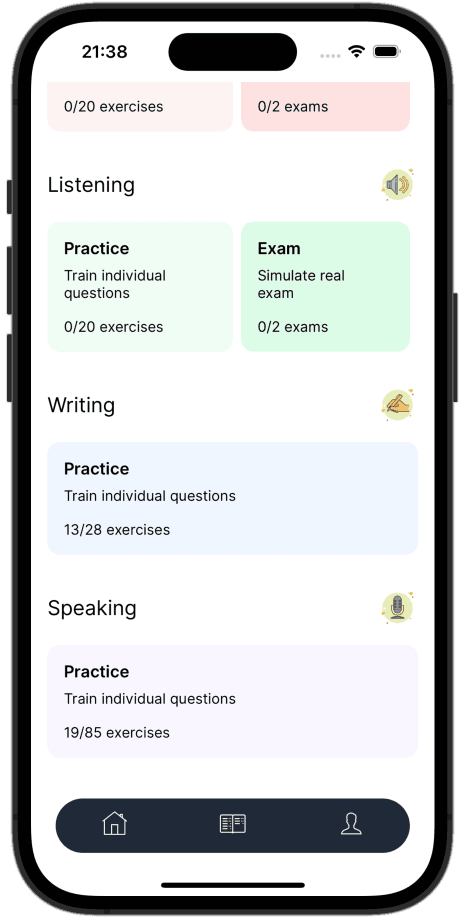
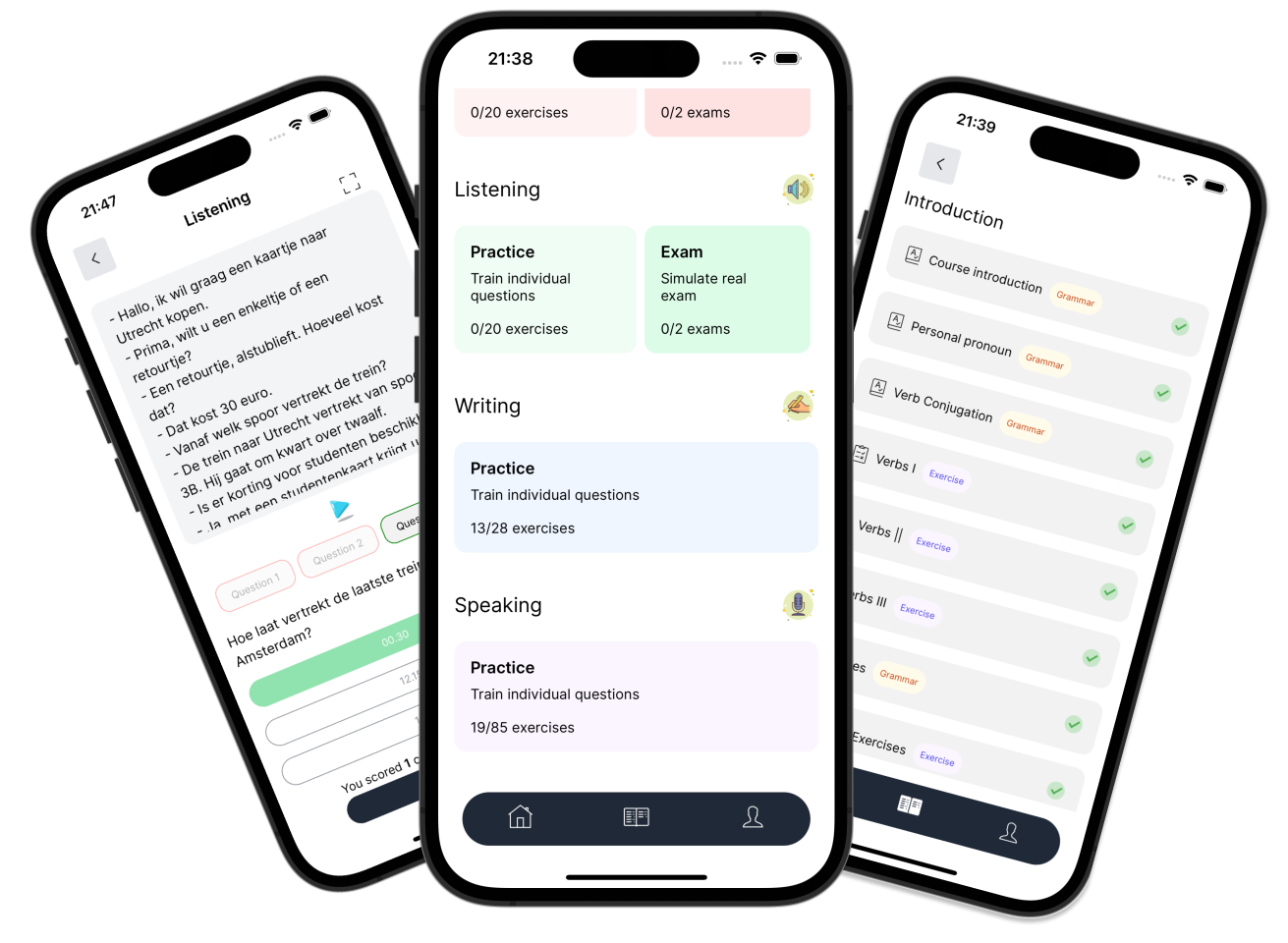
UseDutch is focused on structured A2 preparation. If you are starting from zero, the app includes a simple roadmap from A0 to A2 and practice tools with questions designed to feel similar to the exam format.
Roadmap from zero: follow a step-by-step plan from A0 to A2.
Grammar + vocabulary: learn the building blocks and practice short exercises.
Reading + listening: train with individual exercises or an exam-style simulation, with feedback and explanations.
Speaking + writing: practice common prompts, get AI feedback, and reuse exam-safe templates.
B1/B2: if you need B1/B2, also use official NT2 materials. B1 support in UseDutch is coming.
KNM: the KNM section in the app is coming. Use the KNM guide on this site in the meantime.
If your required level is A2, start with the skills that build confidence fastest, then add speaking and writing.
Start with Reading A2: guide + mini practice.
Then Listening A2: guide + mini practice.
Add Speaking A2: full guide.
Add Writing A2: full guide.
Keep KNM in parallel: topics + practice.
We currently support A2 only. B1 is coming.
Start with the Inburgering A2 hub
Learn grammar and vocabulary with guided practice.
Practice individual exercises or take an exam-style simulation. Get explanations for your mistakes.
Practice prompts, get AI feedback, and compare with model answers.
Coming soon